More Breakdown of the Circumstances behind the Koi Theft at Yucaipa restaurant

Here’s what Led to the Koi Fish Theft

💰 1. High Value of Koi Fish

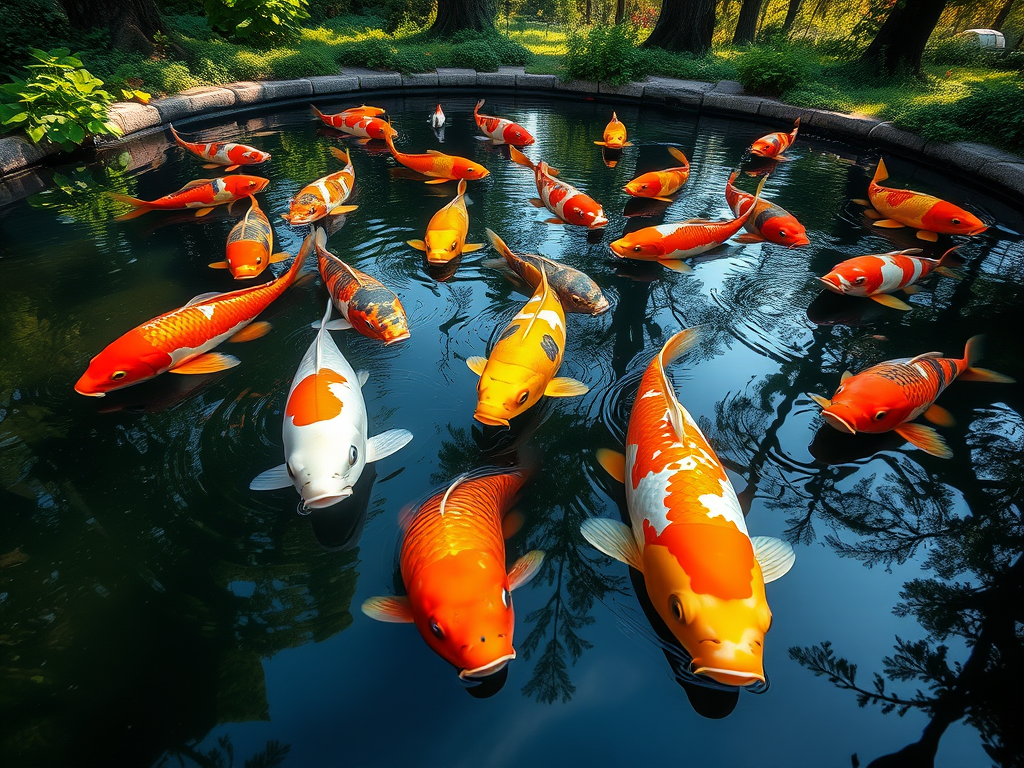
Koi can sell for $50 to $1,500 each, making them a tempting target for theft. With 85 koi stolen, the potential value was significant—even though the exact total was hard to determine.

🕒 2. The Theft Occurred at Night

The incident happened on November 21, when someone stole the koi from the pond outside the Oak House restaurant on Yucaipa Boulevard. Outdoor ponds are often accessible and unmonitored at night, which can make them vulnerable.

👤 3. Two People Were Involved

Surveillance video showed two individuals participating in the theft. Only one—David Smith—was arrested and charged. The second person has not been identified or arrested as of the article’s publication.

🚓 4. Arrest and Charges

Smith was arrested shortly after the theft. Initially charged with felony fish theft, the charge was reduced to misdemeanor grand theft because authorities couldn’t confirm whether the stolen koi exceeded the $950 felony threshold.

🧍 5. Recovered Fish Found With a Homeless Man

Only five koi were recovered. They were found in the possession of a homeless man who said he received them from the thief. The fish were returned to the restaurant’s pond, though one later died.

🐠 6. Restaurant Had to Restock

The restaurant eventually restocked the pond using auction purchases and donations, showing how disruptive the theft was to their business and community presence

Most Lakes and Ponds are filled with Koi, different Species of Fish and other Wildlife

Lakes and ponds often look peaceful on the surface, but beneath that calm water is an entire community of life interacting in ways that keep the ecosystem balanced.

🌿 What Actually Lives in Lakes and Ponds

Most natural lakes and ponds contain:

  • Native fish species like bass, perches, trout, walleyes, carps and koi
  • Amphibians such as frogs, toads, and tortoises
  • Invertebrates like dragonfly larvae, snails, prawns, and water beetles
  • Aquatic plants that provide oxygen and shelter
  • Birds and mammals that rely on the water for food or habitat

🐟 What About Koi?

Koi are not naturally found in most lakes and ponds. They’re ornamental carp typically kept in:

  • Backyard water gardens
  • Decorative ponds
  • Controlled environments where water quality is monitored

If koi are released into natural lakes or ponds, they can actually become invasive, stirring up sediment, uprooting plants, and disrupting native species.

🌎 The Big Picture

Every pond or lake is its own little world. Some are carefully curated (like garden ponds with koi), while natural ones are shaped by climate, geography, and the species that evolved there.

Shaded trees are beneficial in reducing direct sunlight reflections

Trees and Shrubs

Shaded trees are beneficial in reducing direct sunlight reflections. They are necessary when it comes to energy efficiency. Keeping the environment cool, reduces energy spent on air conditional in both commercial and residential buildings.
Large trees and shrubs grows normally in tropical weather conditions and provide the best cooling shade.
The air temperature could be as much as 25 degrees Fahrenheit (F) cooler under trees than around nearby asphalt lots. As is true for vines, in cool and temperate climates placing trees for summer shade and winter sunshine is more complicated than it would first appear. Trees can reduce summer temperatures significantly, especially when they’re located on the south and west sides of the house. Large specimens that shade the roof and walls from the afternoon sun can reduce indoor temperatures by as much as 8 to 10 degrees F. Trees should be located close enough to the house to cast shade but far enough away (typically about 15 feet) that their roots will not damage the foundation. Homeowners should also consider how wide the trees will become when mature, and space them accordingly.

On small city or suburban lots, the optimum location for a shade tree may be in the neighbor’s yard. Homeowners should work with neighbors to plan and plant an energy-conserving neighborhood landscape that improves conditions and lowers costs for everyone. If that’s not possible, homeowners can use shrubs and vines to shade the walls, windows, and air conditioners.

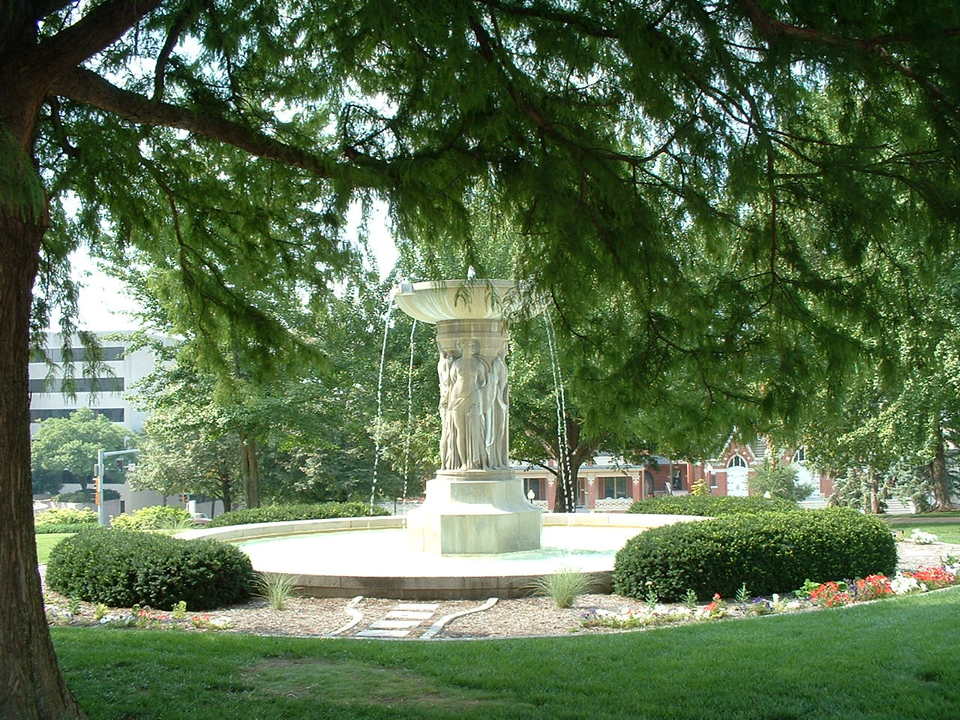
shaded trees   MO Jefferson City - Fountain infront of capitolshaded trees01
Deciduous trees provide shade in summer, then drop their leaves in autumn, allowing the warmth of the sun to filter through their bare branches and help heat the home when the weather is cold. Maples and other tall species with broad leaves and a high, spreading crown are ideal for this purpose. As few as two or three properly spaced trees with wide crowns may suffice, depending on the size of the house. Prune lower branches for maximum heating of walls and roof by the low winter sun.
A 6- to 8-foot deciduous tree planted near a home will typically begin shading windows the first year. Depending on the species and the height of the home, it will shade the roof in five to ten years.
Smaller trees and shrubs can play a role in an energy-conserving landscape as well. Species with branches lower to the ground can be planted closer to the house than tall shade trees and used for shading east- and west-facing walls and windows from the lower morning and afternoon sun. For the greatest ecological benefit, select species native to the region that offer food and shelter for pollinators and other wildlife. Shrubs planted close to the house can fill in rapidly and shade walls and windows relatively quickly. In wet and humid areas, avoid planting them right up against the house so air can circulate freely.

A good windbreak provides protection in more than one direction. A study in South Dakota found that windbreaks located to the west, north, and east of homes cut their fuel consumption by an average of 40 percent. Houses with windbreaks planted only on the windward side, the side of the prevailing winds, averaged 25 percent less fuel consumption than similar but unprotected homes.

The best windbreaks block the wind close to the ground as well as up high, so homeowners should be sure to include species that have low crowns, such as spruces and firs. Evergreen and deciduous trees and shrubs can also be combined with a wall, fence, or earth berm to lift the winds up and over the house. Some air should be able to pass through the windbreak. Impenetrable barriers create a strong vacuum on the protected or leeward side, causing some of the wind to whip up over the top and down, hitting the house instead of lofting over it. Windbreaks composed of living plants naturally allow some of the wind to penetrate, which makes them more effective.

Travel

Fall is a great time to do road travelling with your family and visit some of the festivals taking place in small townships. During this period, schools in these areas are busy with crafts and festivals, decorating, cutting, gluing and pasting posters getting ready to perform musical shows captured during different generations, bringing back memories of famous tunes.

These festivals are full of merchants, selling craftworks and goodies such as caramel apples, cradle popcorn, bake goods and warm clothing for the season. Knitted and crocheted wares made from a combination of different colors with similar textures or bright colors are appropriate for the season.

I and my family have gotten use to visiting some of the local townships located in the South and Southwest of Minnesota – Twin cities heading towards Iowa and South Dakota. During vacations like these, its usually nice to book in advance nearby hotels, mini hotels, eco-lodges or motels depending on your budget and distance from the sites of interest. If you folks plan to enjoy the night life entertainment, you may be looking at locations further form points of interests. It all depends on how you want to joggle your vacation.

Holiday Inn Express, SD

Holiday Inn Express, SD

If you are a family with younger children, you may want to settle in a nearby location close to your point of interest. Before booking your trip, check out the amenities. Swimming pool is always a plus and your family will enjoy the night hours when you folks are off from visiting these locations of interests and season festivities.

Check out state guides for season festivities and also the national park and recreation guides. Pine city, SD, and other nearby state parks may have special activities going on during your vacation.

VALERO – Corporation and Subsidiaries

Valero Corporate HeadquartersOverview

Today, the 200-acre Valero campus includes a main building; two connected newer office buildings; a four-story, separate building; and two large parking facilities. The headquarters also features a beautiful cafeteria, state-of-the-art training facilities, a fitness center, a daycare facility and jogging trails. Valero employees also went to great lengths to protect the environment, saving and relocating hundreds of trees as well as installing a water recycling system to help reduce costs and conserve water.

The headquarter is located in SAn Antonio – Texas and have offices in other locations listed here.

Valero’s natural-gas transportation business diversified in the mid-1980s when the company purchased a 50 percent interest in a Corpus Christi, Texas, refinery owned by Saber Energy. The operation began as nothing more than a vacuum unit and crude unit on a humble plot of land near the Corpus Christi Ship Channel. But in the years that followed, Valero assembled its “Refinery of the Future,” and through its subsidiaries added more refineries starting in 1997, with 15 plants today. Through these acquisitions, the company also branched into retail and wholesale markets, and today supplies independently owned wholesale outlets carrying the Valero, Diamond Shamrock, Shamrock and Beacon brands in the United States and the Caribbean; Ultramar in Canada; and Texaco in the United Kingdom and Ireland.

Today, Valero proudly has a workforce of about 10,000 employees and a refining throughput capacity of approximately 2.9 million barrels per day, making it the world’s largest independent refiner — tops among refiners that don’t also drill for oil. The company ranks No. 13 on the current Fortune 500 list, and is still based in its hometown of San Antonio. Valero is also a leading ethanol producer with 11 ethanol plants in the Midwest and a combined production capacity of 1.3 billion gallons per year. Valero also operates a 33-turbine wind farm near its McKee Refinery in Sunray, Texas.

Oil Refineries

Oil Refineries

Valero maintains a strong commitment to safety and stands as one of the most recognized refiners within the federal OSHA Voluntary Protection Program (VPP). The company demonstrates its commitment to excellence in occupational safety and process safety through an intensive, detailed Commitment to Excellence Management System. And it continues to be recognized among the world’s top refining and marketing companies, and among the nation’s best employers.

In the community, Valero is proud of its legacy of support and positive outreach through an international network of Volunteer Councils. Valero Volunteers proudly dedicate more than 136,000 volunteer hours to community outreach annually. Special missions on behalf of the United Way, the National Multiple Sclerosis Society, Wounded Warriors and countless children’s charities are a source of pride and motivation for every Valero employee. Valero, its employees and its philanthropic organization – the Valero Energy Foundation – annually generate more than $38 million to support worthy charities or causes, through direct donations or fundraising, to improve the lives of those living in communities near Valero operations.

New construction endeavors plant timeline in Iowa:More info
  • January 2003 – Community leaders began working on plans for the plant
  • May 2004 – Announced purchase of land in Webster County near Fort Dodge
  • July 2004 – Construction began
  • September 2004 – Groundbreaking celebrated
  • September 2005 – Operations began
  • December 2005 – Grand opening celebrated
  • April 2009 – Valero Renewables closed on purchase of the plant from VeraSun Energy

Northern Flicker

Northern flickers are commonly found in the Southern part of the U.S. but lately, due to warm temperatures experienced around Canada, they are getting to be very popular all over the U.S. and especially in the Midwest. Because of the warmer temperatures, these species of birds are present throughout the seasons. They travel distances to the South when it starts getting cold to avoid the winter snowy weather.

Northern flickers turn to have their off springs twice a year and the number of off springs ranges from 4 to 6 at a time. They feed on wood chips, barks of wood, nuts and dried bread crumbs.

northern_flicker

Their nests are made of dried sticks, petals and sods with feathers and cotton to add a layer of cushion to protect their off springs as well as keeping them comfortable and save when its cold or rainy. They are early risers and I can hear them chipping, chipping, chipping on wood barks making  wreaky, wreaky, wreaky sounds attracting other birds to their location such as bluebirds, cardinals and yellow birds from the back of my bathroom window. They are drawn and attracted to areas where River birch trees are common and you can see them from a distance flying and landing, creating beautiful colorful sceneries.


Monarch butterfly

The Life Cycle(s) of a Monarch Butterfly

Monarch butterflies go through four stages during one life cycle, and through four generations in one year.  It’s a little confusing but keep reading and you will understand.  The four stages of the monarch butterfly life cycle are the egg, the larvae (caterpillar), the pupa (chrysalis), and the adult butterfly.  The four generations are actually four different butterflies going through these four stages during one year until it is time to start over again with stage one and generation one.

In February and March, the final generation of hibernating monarch butterflies comes out of hibernation to find a mate.  They then migrate north and east in order to find a place to lay their eggs.  This starts stage one and generation one of the new year for the monarch butterfly

Butterflies.
In March and April the eggs are laid on milkweed plants. They hatch into baby caterpillars, also called the larvae.  It takes about four days for the eggs to hatch.  Then the baby caterpillar doesn’t do much more than eat the milkweed in order to grow.  After about two weeks, the caterpillar will be fully-grown and find a place to attach itself so that it can start the process of metamorphosis.

It will attach itself to a stem or a leaf using silk and transform into a chrysalis. Although, from the outside, the 10 days of the chrysalis phase seems to be a time when nothing is happening, it is really a time of rapid change. Within the chrysalis the old body parts of the caterpillar are undergoing a remarkable transformation, called metamorphosis, to become the beautiful parts that make up the butterfly that will emerge.
Caterpillarturning intoChrysalis
Monarch: Larvae (caterpillar) turning into Pupa (Chrysalis) Cocoons

Monarch Pupa
Monarch: Pupa (Chrysalis) turning into Adult Butterfly
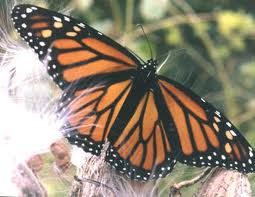
The monarch butterfly will emerge from the pupa and fly away, feeding on flowers and just enjoying the short life it has left, which is only about two to six weeks. This first generation monarch butterfly will then die after laying eggs for generation number two.

The second generation of monarch butterflies are born in May and June, and then the third generation will be born in July and August.  These monarch butterflies will go through exactly the same four stage life cycle as the first generation did, dying two to six weeks after it becomes a beautiful monarch butterfly.
The fourth generation of monarch butterflies are a little bit different than the first three generations.  The fourth generation are born in September and October and goes through exactly the same process as the first, second and third generations except for one part. The fourth generation of monarch butterflies does not die after two to six weeks.  Instead, this generation of monarch butterflies migrates to warmer climates like Mexico and California and will live for six to eight months until it is time to start the whole process over again.