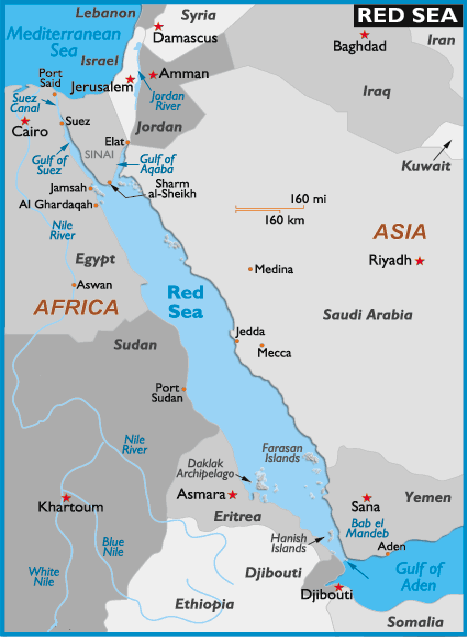
 Red Sea
Is an extension (or inlet) of the Indian Ocean, located between Africa and Asia.
Entrance to the sea in the south is through the Gulf of Aden and the somewhat narrow Bab el Mandeb (strait).
In the north the sea is accessed from Middle Eastern countries via the Gulf of Aqaba (or Gulf of Eilat.) The Mediterranean Sea provides a conduit south through the Suez Canal and Gulf of Suez.
This salty sea is just over 190 miles (300 km) across at its widest point, and It stretches approximately 1,400 miles (2,250 km) from the Suez Canal in the north to the Bab-el-Mandeb Strait in the south.
There’s a measured maximum depth of 8,200 feet (2,500 m), and an estimated average depth of 1,640 feet (500 m). Much of the immediate shoreline is quite shallow.
With hot sunny days, and the lack of any significant rainfall, desert dust storms are known to sweep across the sea. High heat combined with the lack of precipitation facilitates high levels of evaporation – thus the sea’s high salinity.
Regardless, the consistent sunshine, as well as white sand beaches, pristine coral reefs and a scattering of shipwrecks are major attractions for scuba divers and sun worshipers. Resorts like Sharm al-Sheikh and others in Egypt’s “Red Sea Riviera” along the Gulf of Aqaba and Gulf of Suez are fast becoming major tourist destinations.

- Eastern Shore (Asia):
-
Saudi Arabia: Has the longest coastline on the Red Sea.
-
Yemen: Located at the southern end.
-
- Western Shore (Africa):
- Northern Tip (Gulf of Aqaba):
-
Israel: Has a short coastline at its southernmost city, Eilat
-
Jordan: Has access through its only port city, Aqaba.
-
Key Geographic Features
- Northern Connection: It connects to the Mediterranean Sea via the Suez Canal in
- Southern Connection: It connects to the Gulf of Aden and the Indian Ocean through the Bab el-Mandeb Strait.
- Divisions: At its northern end, the sea splits into the Gulf of Suez (west) and the Gulf of Aqaba (east), separated by Egypt‘s Sinai Peninsula.
- Dive into the unique marine biodiversity of the Red Sea, home to over 1,200 species of fish.
- Learn about the geological formation of the Red Sea as part of the Great Rift Valley.
- Explore the sustainable tourism projects currently being developed along the Saudi Arabian coastline.
The most widely accepted scientific explanation is the presence of a type of cyanobacteria (algae) called Trichodesmium erythraeum.
- How it works: This algae is normally blue-green, but when it blooms in large quantities or dies off, it turns the water’s surface a reddish-brown or rusty color.
- Ancient Sightings: Early mariners likely observed these occasional patches of red water and named the sea accordingly.
- The Theory: “Red” often symbolized the south, while “black” symbolized the north.
- Comparison: Just as the Black Sea is in the north from an ancient perspective, the Red Sea was the “Southern Sea”.
- Red Mountains: The nearby red-tinged mountain range, known as Harei Edom (Mountains of Edom), can cast a red glow onto the water, especially at sunrise or sunset.
- Egyptian Desert: Ancient Egyptians referred to the neighboring desert as the “Red Land” (Deshret), potentially leading to the name “Sea of the Red Land”.
The modern name is a literal translation of its ancient Greek name, Erythra Thalassa (Red Sea).
- Mistranslations: In Hebrew, the sea is called Yam Suph, which traditionally translates to “Sea of Reeds”. It is believed that early Greek translators might have mistranslated this or substituted it with their own descriptive name for the region.
- Targeted Attacks: Since late 2023, Houthi militants in Yemen have frequently used missiles and drones to attack commercial vessels.
- Strategic Chokepoints: The Bab el-Mandeb Strait (meaning “Gate of Tears”) is a narrow, 29km-wide passage that has become a high-risk zone for hijackings and boardings.
- Global Impact: These security threats have forced many shipping companies to reroute around Africa, significantly increasing costs and insurance premiums.
- Strong Currents & Winds: The sea is known for unpredictable local currents and strong north-westerly winds that can make swimming and sailing treacherous, especially for beginners.
- Brine Pools: Researchers have discovered “death pools” on the ocean floor—pockets of water up to eight times saltier than the rest of the sea that lack oxygen and can be fatal to marine life that enters them.
- Extreme Salinity: It is one of the saltiest bodies of water in the world, which can be harsh for those not used to its buoyancy and chemical makeup.
- Venomous Species: The Stonefish is masterfully camouflaged and has venomous spines that can penetrate shoes and be fatal. and Scorpionfish also possess painful, venomous spines used for defense.
- Aggressive Fish:
Titan triggerfish and Yellowmargin triggerfish are known to aggressively guard their nests and can deliver severe bites to divers who get too close.
-
: While attacks are rare, the Red Sea is home to over 40 shark species. The Oceanic Whitetip
, Tiger shark, and Shortfin Mako are considered the most dangerous to humans, especially swimmers near the surface.
- Learn more about maritime safety and risk assessments for the region from Azure Risk.
- Explore a detailed guide on hazardous marine species and first aid tips at Egypt Dive.
- Read about the strategic importance and historical security of the Suez Canal at the Atlantic Council.

Ports along The Red Sea
- Energy Products: A significant volume of crude oil and diesel fuel passes through this route to Europe.
- Containerized Cargo: Finished goods, including clothes, electronics, trainers, and industrial components, are transported through this channel.
- Agricultural and Industrial Commodities: Palm oil, grains, and raw materials are frequently shipped through the region.
- Recent Shifts: Due to increased security risks, some shipments of commodities like coal have shifted to alternative routes.
- Volume: Approximately 12% of total global trade and over 20,000 ships pass through the Suez Canal and Red Sea annually.
- Strategic Chokepoint: The Bab-el-Mandeb Strait, which connects the Red Sea to the Gulf of Aden, is a vital, narrow (26 km) passage.
- Current Disruptions: Since late 2023, Houthi attacks have caused significant declines in traffic, forcing many companies to reroute, adding 10-14 days to journeys.
- Fisheries: While the Red Sea is more famous for its coral reefs, it supports local fishing industries.
- Mineral Exploitation: Oil and natural gas deposits are heavily exploited, particularly near the Jamsah (Gemsa) Promontory in Egypt.
- Unexploited Resources: Large amounts of sulfur and heavy metal deposits exist but are not heavily exploited.
- Shipping Costs: The diversion of ships has increased fuel consumption and freight rates, often costing upwards of $30,000-$35,000 per day in fuel for large vessels.
- Supply Chain Delays: Disruptions threaten global supply chains and contribute to increased inflation due to delayed consumer goods.

Cities along the border of The Red Sea

You must be logged in to post a comment.