Shaded trees are beneficial in reducing direct sunlight reflections. They are necessary when it comes to energy efficiency. Keeping the environment cool, reduces energy spent on air conditional in both commercial and residential buildings.
Large trees and shrubs grows normally in tropical weather conditions and provide the best cooling shade.
The air temperature could be as much as 25 degrees Fahrenheit (F) cooler under trees than around nearby asphalt lots. As is true for vines, in cool and temperate climates placing trees for summer shade and winter sunshine is more complicated than it would first appear. Trees can reduce summer temperatures significantly, especially when they’re located on the south and west sides of the house. Large specimens that shade the roof and walls from the afternoon sun can reduce indoor temperatures by as much as 8 to 10 degrees F. Trees should be located close enough to the house to cast shade but far enough away (typically about 15 feet) that their roots will not damage the foundation. Homeowners should also consider how wide the trees will become when mature, and space them accordingly.
On small city or suburban lots, the optimum location for a shade tree may be in the neighbor’s yard. Homeowners should work with neighbors to plan and plant an energy-conserving neighborhood landscape that improves conditions and lowers costs for everyone. If that’s not possible, homeowners can use shrubs and vines to shade the walls, windows, and air conditioners.
Deciduous trees provide shade in summer, then drop their leaves in autumn, allowing the warmth of the sun to filter through their bare branches and help heat the home when the weather is cold. Maples and other tall species with broad leaves and a high, spreading crown are ideal for this purpose. As few as two or three properly spaced trees with wide crowns may suffice, depending on the size of the house. Prune lower branches for maximum heating of walls and roof by the low winter sun.
A 6- to 8-foot deciduous tree planted near a home will typically begin shading windows the first year. Depending on the species and the height of the home, it will shade the roof in five to ten years.
Smaller trees and shrubs can play a role in an energy-conserving landscape as well. Species with branches lower to the ground can be planted closer to the house than tall shade trees and used for shading east- and west-facing walls and windows from the lower morning and afternoon sun. For the greatest ecological benefit, select species native to the region that offer food and shelter for pollinators and other wildlife. Shrubs planted close to the house can fill in rapidly and shade walls and windows relatively quickly. In wet and humid areas, avoid planting them right up against the house so air can circulate freely.
Tanzania – Coral Beach
A good windbreak provides protection in more than one direction. A study in South Dakota found that windbreaks located to the west, north, and east of homes cut their fuel consumption by an average of 40 percent. Houses with windbreaks planted only on the windward side, the side of the prevailing winds, averaged 25 percent less fuel consumption than similar but unprotected homes.
The best windbreaks block the wind close to the ground as well as up high, so homeowners should be sure to include species that have low crowns, such as spruces and firs. Evergreen and deciduous trees and shrubs can also be combined with a wall, fence, or earth berm to lift the winds up and over the house. Some air should be able to pass through the windbreak. Impenetrable barriers create a strong vacuum on the protected or leeward side, causing some of the wind to whip up over the top and down, hitting the house instead of lofting over it. Windbreaks composed of living plants naturally allow some of the wind to penetrate, which makes them more effective.
American air force fighterjets based in Korea Aerospace Industries (KAI) T-50 supersonic aircrafts propel and maneuver by AF trainees, with deliveries due to be completed by 2017. The order, including training, which is valued at $1.1 billion, but the U.S. says supporting the Korean Aerospace Industries (KAI) over a period of 20 years, also with contracts will take a total revenue beyond $2 billion.
Though Iraq’s aircrafts are designated T-50IQ, an industry official says the aircrafts were built to the design of the FA-50 light attack variant of the T-50 family. Powered by single General Electric F404 engine, the T-50 is a contender for the U.S. Air Force’s T-X trainer’s requirement.
KAI’s T-50 program has strengthened considerably this year after averaging a production rate of within a period of two months since deliveries began in 2005. The production rate is now twice monthly, not far below capacity of 2.5 a month, KAI says. While the exact state of orders and deliveries is unknown, it is clear that the program has sufficient orders to maintain the monthly rate of supersonic jets until 2017. Iraq’s first T-50IQ is due to be delivered in April 2016 and the last in April 2017.
This is the type secondly ordered in 2013. In May, the South Korean defense ministry ordered about 400 FA-50s due for delivery to the South Korean air force by the end of 2016. Meanwhile, KAI this year began deliveries of a first batch of 20 FA-50s ordered for the South Korean air force in 2012 and 106 TA-50s that Indonesia ordered in 2011.
In October South Korea confirmed that the Philippines had chosen the FA-50 for a requirement for 120 aircrafts, but that country has not placed an order. KAI says it is also pursuing possible orders from Chile and Botswana.
The BAE Systems Hawk was a contender for the Iraq order. KAI says it also beat competition from the Yakovlev Yak-130 and Aero L-159.
KAI has not said how many FA-50s were covered by the South Korean defense ministry’s May order. An industry source said then that it was “about 100.” The figure is likely to be exactly 60, since the air force likes to order fighters in multiples of 20.
Samsung Techwin assembles and partly makes F404 engines for the T-50 family. The airframe, developed with much help from Lockheed Martin, is based on the aerodynamics of the F-16, which Iraq has also ordered.
Bodice detail of 1760s gown made from very fine silk (lustring). The small flower pattern in off-white woven into the pale vanilla cream background suggests a date of around 1755 for the fabric, though the gown was made possibly a decade later. Alabama
Do your life a big favor today, completely let go of the old, so you can fully embrace the Glory of the New. You haven’t anymore time or space for the old, because you’re making room for the new of what Jehovah Sabaoth is doing in your life. Jehovah is doing some things in your life, that have never been done before.
You are experiencing the greatest harvest of blessing you have ever harvested in your life. Your limitations and nets of what you’ve believed for are being broken, for I am breaking your nets and changing your status says The Lord. No more will you settle, second guess, and be able to reference what has been, for I am doing more for you, releasing more to you, and causing you to live under an Unlimited Open heaven! There are so many holes in the sky over you, for heaven is dripping with fresh grace, Holy Rain, and Abundance over you.
Truth, new revelation of Truth, My truth is making you Free. Free to make the right choices, no more religious, self, or confinement of the past. You are moving forward leaving the past behind. You are rising up as the shameless warrior, the fearless warrior, worshiping in the new wave of My Glory.
Every altar of Baal, false worship, and witchcraft is destroyed and denounced from your life. There are so many ways to worship, that you haven’t even entered into yet. Enter in, enter in, enter in the fresh wineskin presence of the King. For you are in the place. where the eagles soar and they don’t come down, they just go higher. For I am changing everything as you have known it, to a more intimate knowing in your heart and not just your head. Heart therapy, the Glory is doing heart therapy, bringing us into a more tangible unfeigned love for one another.
Behold, the beauty of the bride in pure unity and wholeness. I loose your tongue today, to articulate the language of the Kingdom, which is the heart of the King Lion of Judah! Give voice to His Voice. Make way for His ways. For the Glory of the King, encumbers our hearts with the encumbers of His heart. You are chambered by the Glory, loosed to fulfill.
Great destiny is upon you, great, great destiny is upon us, divorce the old, marry the New…Selah
Rig Veda begins with the invocation of Lord Ganesha, who is described as the Chief of Ganas (divine beings) and as the Supreme Seer (Rig Veda 2.23).
The Bhagwad Gita is an episode which has been very eloquently given in the great epic Mahabharata in Sanskrit. It is a prominent religious text. It is in the form of a dialogue between Dhanushdhari Arjuna and Lord Krishna; an incarnation of Lord Vishnu. The same was dictated by Maharishi Ved Vyasa and penned down by Lord Ganesha, a reservoir of knowledge and wisdom. He wrote the dialogue without any interruption.
Significantly, when this Mantra ‘Om Gan Ganapataye Namo Namah; is recited 108 times, it will result in bountiful blessings of LORD GANESHA.
LORD GANESHA
Lord Ganesha is considered to be the first deities to be venerated While any new business or any venture is to be initiated Since He is worshipped as the most bountiful and benevolent.
Worshipped as Vinayaka, Ganesha or Ganapati Possessing all encompassing potencies He is most easily identified With elephant head Ganesha is born out of the dirt Rubbed out of the body of Adi Shakti Proving that every speck of Mother Nature is significant This also prove without even an iota of doubt That even the worthless matter matters most And could have immense power when properly harnessed In righteous spirit.
When a new venture has to see the light of the day Or starting educational pursuit is sought to start Along also for getting peace and prosperity for us all For smooth sailing in anything we take on We seek His blessings of Lord Ganesha for success of our mission.
Ganesha has two consorts Named Ridhi and Sidhi Ridhi is responsible for our prosperity Sidhi is for getting spiritual orientation in our existence Including increasing positive thoughts for actionable results.
Lord Ganesha is also worshipped For ensuring protection From the ill-omens Along with increasing the power of recreation Whilst removing obstacles from our path Because Lord Ganesha Is considered as the patron Of wisdom and intellect in abundance He is both Veghanaharta The one who removes the obstructions from amongst us all And a Vegana Karta an obstacle creator for the evil doers.
My sincere prayer to Thee our Lord Ganesha To bestow us peace & prosperity to all Including harmony between all communities So that goodness prevails all around without bias.
HAPPY GANESHA CHATURITHI TO ALL
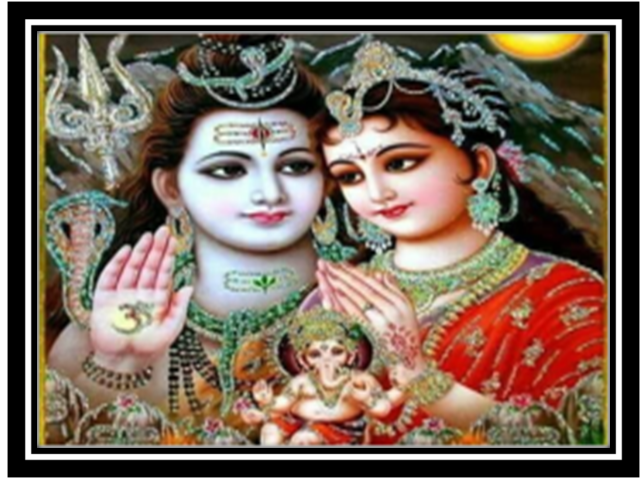
Before delving on as to why we celebrate Ganesh Chatruthi, it is essential that we should know the circumstances and how life was infused in a lifeless creation by Goddess Parvti – the Shakti with unlimited power.This lifeless creation was the smut obtained after scrapping the remains of sandalwood paste applied on her body or dead cells scrubbed out of the body of Maa Parvati. She was so much attracted to her creation that she infused life into the lifeless matter.
Ganesh Chaturthi or Vinayak Chaturthi is celebrated on the birthday of Lord Ganesha – which falls between 19th August to 20th September every year. This year, His birthday falls on 19th of September. He is the most loved son of Lord Shiva and Goddess Parvati. The devotees’ firm belief is that on this most auspicious day, He bestows his bountiful blessings on us with His presence and showers His graces (shuvta) on us as He is the Lord of prosperity, unlimited wisdom, and a trouble shooter to the core.
LORD GANESHA IS CONSIDERED TO BE THE MOST BENEVOLENT DEITY
The Ganesha’s birthday is celebrated according to the Hindu Calendar month of Bhaadrapada starting with the Shukla Chaturthi – 4th day of the waxing moon period till 14th day of waxing of moon. There is a celebration of ten days for which comprehensive preparations are made before hand. This includes; procuring lovely idol of Lord Ganesha, preparation of eatable, especially modaks for friends and relatives, some install Ganesha Idol on this day at their homes for getting His graces. This festival is celebrated in almost all the parts of India. Even in foreign countries like Canada, USA, UK etc where Indians are there, this festival is celebrated with huge joy and enthusiasm. It has special relevance in Maharashtra.
HOW THE BIRTHDAY OF LORD GANESHA CAE ABOUT?
Legend has it that Goddess Parvati created Ganesha out of sandalwood paste which was applied on Her body before taking bath. She was impressed by her own creation which ignited her curiosity of breathing/infusing life into that creation. Low and behold, the creation of Maa Parvati came to life!
Subsequently, Maa Parvati told him to guard the entrance of the bathroom and ordered him not to allow anybody enter it while she was taking bath and attending to other rituals. All this transpired when Lord Shiva had gone somewhere. When He returned back, Ganesha, standing guard at the entrance, did not allow Him to enter. When he was asked as to who he was. Ganesha replied that he was Ganesha the son of Maa Parvati!
Lord Shiva sent His Ganas including powerful Nandi wanted to teach the child a lesson in mannerism. As Ganesha was created by Shakti, he was very powerful besides being obedient to the core. Indira and his army of demigods too used their power to overpower Ganesha but in vain.
Thereafter, it was the turn of Narda with Saptarishis who came for persuading the child for allowing Lord Shiva but it was also a futile exercise. All this infuriated Lord Shiva still further. Out of anger, He cut the head of Ganesha with His Trident. When Maa Parvati came out after Her bath, she found the severed head from the body of her creation. This tragic scene enraged her immensely. Observing her state of mind, Lord Shiva promised to bring back to life their son. For this purpose, the Demigods went in search of the person facing north. They could not find any humans. They could find bring the elephant’s head which was fixed on the headless body. Ganesha came back to life instantly through the supernatural powers of Lord Shiva. He was graced with several bounties by Lord Shiva and other Demigods.The purpose of this creation by removing the egocentric tendencies based small head of Ganesha in the initial stage of creation and replacing with bigger Gajhead with immense wisdom and sagacity with no ego at all.
The intention was to bring about this change was to transform the trait of the creation of Goddess Parvati from negative to positive orientation by Lord Shiva. This infusion of positivity in Lord Ganesha; with immense wisdom and intelligence is beneficial to us devotees. And that is why we all worship Lord Ganesha to get all the bounties with our sincere prayers onto Him. This also is a lesson for us humans that we should transform our negative tendencies to positive ones for overall good both for ourselves and for the society in which we have to play our role in various form, from birth to death.
Modhak (dumpling made out of grinded rice, mixed with sugar, jugglery, fruits etc) is the choicest eatable of Lord Ganesha.
WHY GANESH CHATURATHI IS CELEBRATED?
Previously, only Hindus used to participate in the festivities but presently there is a community participation in this festival. There is enactment of concerts; discourses based on intellectual/spirituality related topics, skits, folk dances etc. Dahi Handi competition is another interesting and much awaited by the participants. Here prizes are also given. People of all castes, religions and colour participate in these festivities and this becomes a fertile ground for national integration and engenders understanding between different communities. All these activities have twofold benefits. Firstly, it enhances unity in diversity and secondly it ensures competitive fervor between people.
As Lord Ganesha is embodiment of good tidings, people start their new businesses on this most auspicious day so as to have His blessings for the success.
From the above, it is evident that this auspicious day of Ganesh Chatruthi is celebrated for ensuring cohesion / unity between all the communities, encourage non-discriminatory ideas/ideals besides getting opportunity to celebrate the auspicious occasion imbibing spiritual onward march and finally to get Lord Ganesh’s bounties of unlimited intelligence and wisdom.
LORD GANESHA’S WISDOM IS WELL KNOWN
He is the one who penned down Mahabharta dictated by sage Vyasa at one sitting itself. This shows his wisdom, patience and persistence.
Lord Ganesha is known by 108 names but the following are its prominent ones:
VIGHNAHARTA
Vighna means problems or troubles whereas harta means to remove. It goes to show that Lord Ganesha has the power to remove the impediments or troubles from our midst.
VINAYAKA
Vinayaka is similar to Vighanaharta; the one who removes troubles from our midst.
GAURISUTA
Gaurisuta means son of Gauri (another name of Goddest Parvati). She is possessing all the powers to remove any hurdles which comes in our way.
BALCHANDRA
Balchandra; Bala means child and Chandra is associated with moon. Lord Ganesha carries the moon as a holy sign (Tilk) on his forehead.
EKADANTA
Eka signifies single or one danta means tooth oor tusk. When Parashuram got very angry with child Ganesha, when he came in his way when he wanted to meet Lord Shiva, Parashuram chipped one of Ganesha teeth.
VAKRATUNDA
It means Ganesha is the first incarnation. VAKRA means curved and TUNDA mwans trunk. He is known to have regain the kingdom of Gods by overpowering demon Matsara with his power and intelligence. Chanting OM BAKRATUNDA AHE NAMON will make us a candidate for Lord Ganesha’s graces.
LAMBODRA
It means the one who has a huge belly. According to Mudgala Purana, Lord Ganesha is Lambodara Avtara. He helped in protecting the Gods from Krodasura.
KRISHNAPINGAKSHA
It is said that Lord Ganesha is known to have the characteristic of seeing everything from anywhere and anywhere. It also shows that he had the same traits as Lord Krishna (The Avtara of Lord Vishnu).
MY SINCERE PRAYERS TO LORD GANESHA
May Lord Ganesha, who is very benevolent and compassionate to His devotees, my sincere prayer to Lord Ganesha to bring about peace, prosperity and wellness to all the humanity of the world as whole . Also, my prayer to Lord Ganesha is to rid us all from the natural calamities which is proving dangerous for the entire world at large. As things stands out, as He protects us from all the misfortunate incidents besides bestowing us peace and prosperity. As He enhances our knowledge and wisdom, I pray for providing us both so that spread knowledge and sagacity to use the same for overall benefits of the humankind.
MAY HIS BOUNTIFUL BLESSING REMAIN ON US ALL FOR PEACE AND PROSPERITY OF HUMANITY.
HAPPY GANESH CHATURITHI TO ALL ON 19TH SEPTEMBER 2023
LORD GANESHA
Rig Veda begins with the invocation of Lord Ganesha, who is described as the Chief of Ganas (divine beings) and as the Supreme Seer (Rig Veda 2.23).
The Bhagwad Gita is an episode which has been very eloquently given in the great epic Mahabharata in Sanskrit. It is a prominent religious text. It is in the form of a dialogue between Dhanushdhari Arjuna and Lord Krishna; an incarnation of Lord Vishnu. The same was dictated by Maharishi Ved Vyasa and penned down by Lord Ganesha, a reservoir of knowledge and wisdom. He wrote the dialogue without any interruption.
Significantly, when this Mantra ‘Om Gan Ganapataye Namo Namah; is recited 108 times, it will result in bountiful blessings of LORD GANESHA.
LORD GANESHA
Lord Ganesha is considered to be the first deities to be venerated While any new business or any venture is to be initiated Since He is worshipped as the most bountiful and benevolent.
Worshipped as Vinayaka, Ganesha or Ganapati Possessing all encompassing potencies He is most easily identified With elephant head Ganesha is born out of the dirt Rubbed out of the body of Adi Shakti Proving that every speck of Mother Nature is significant This also prove without even an iota of doubt That even the worthless matter matters most And could have immense power when properly harnessed In righteous spirit.
When a new venture has to see the light of the day Or starting educational pursuit is sought to start Along also for getting peace and prosperity for us all For smooth sailing in anything we take on We seek His blessings of Lord Ganesha for success of our mission.
Ganesha has two consorts Named Ridhi and Sidhi Ridhi is responsible for our prosperity Sidhi is for getting spiritual orientation in our existence Including increasing positive thoughts for actionable results.
Lord Ganesha is also worshipped For ensuring protection From the ill-omens Along with increasing the power of recreation Whilst removing obstacles from our path Because Lord Ganesha Is considered as the patron Of wisdom and intellect in abundance He is both Veghanaharta The one who removes the obstructions from amongst us all And a Vegana Karta an obstacle creator for the evil doers.
My sincere prayer to Thee our Lord Ganesha To bestow us peace & prosperity to all Including harmony between all communities So that goodness prevails all around without bias.
HAPPY GANESHA CHATURITHI TO ALL
Before delving on as to why we celebrate Ganesh Chatruthi, it is essential that we should know the circumstances and how life was infused in a lifeless creation by Goddess Parvti – the Shakti with unlimited power.This lifeless creation was the smut obtained after scrapping the remains of sandalwood paste applied on her body or dead cells scrubbed out of the body of Maa Parvati. She was so much attracted to her creation that she infused life into the lifeless matter.
Ganesh Chaturthi or Vinayak Chaturthi is celebrated on the birthday of Lord Ganesha – which falls between 19th August to 20th September every year. This year, His birthday falls on 19th of September. He is the most loved son of Lord Shiva and Goddess Parvati. The devotees’ firm belief is that on this most auspicious day, He bestows his bountiful blessings on us with His presence and showers His graces (shuvta) on us as He is the Lord of prosperity, unlimited wisdom, and a trouble shooter to the core.
LORD GANESHA IS CONSIDERED TO BE THE MOST BENEVOLENT DEITY
The Ganesha’s birthday is celebrated according to the Hindu Calendar month of Bhaadrapada starting with the Shukla Chaturthi – 4th day of the waxing moon period till 14th day of waxing of moon. There is a celebration of ten days for which comprehensive preparations are made before hand. This includes; procuring lovely idol of Lord Ganesha, preparation of eatable, especially modaks for friends and relatives, some install Ganesha Idol on this day at their homes for getting His graces. This festival is celebrated in almost all the parts of India. Even in foreign countries like Canada, USA, UK etc where Indians are there, this festival is celebrated with huge joy and enthusiasm. It has special relevance in Maharashtra.
HOW THE BIRTHDAY OF LORD GANESHA CAE ABOUT?
Legend has it that Goddess Parvati created Ganesha out of sandalwood paste which was applied on Her body before taking bath. She was impressed by her own creation which ignited her curiosity of breathing/infusing life into that creation. Low and behold, the creation of Maa Parvati came to life!
Subsequently, Maa Parvati told him to guard the entrance of the bathroom and ordered him not to allow anybody enter it while she was taking bath and attending to other rituals. All this transpired when Lord Shiva had gone somewhere. When He returned back, Ganesha, standing guard at the entrance, did not allow Him to enter. When he was asked as to who he was. Ganesha replied that he was Ganesha the son of Maa Parvati!
Lord Shiva sent His Ganas including powerful Nandi wanted to teach the child a lesson in mannerism. As Ganesha was created by Shakti, he was very powerful besides being obedient to the core. Indira and his army of demigods too used their power to overpower Ganesha but in vain.
Thereafter, it was the turn of Narda with Saptarishis who came for persuading the child for allowing Lord Shiva but it was also a futile exercise. All this infuriated Lord Shiva still further. Out of anger, He cut the head of Ganesha with His Trident. When Maa Parvati came out after Her bath, she found the severed head from the body of her creation. This tragic scene enraged her immensely. Observing her state of mind, Lord Shiva promised to bring back to life their son. For this purpose, the Demigods went in search of the person facing north. They could not find any humans. They could find bring the elephant’s head which was fixed on the headless body. Ganesha came back to life instantly through the supernatural powers of Lord Shiva. He was graced with several bounties by Lord Shiva and other Demigods.The purpose of this creation by removing the egocentric tendencies based small head of Ganesha in the initial stage of creation and replacing with bigger Gajhead with immense wisdom and sagacity with no ego at all.
The intention was to bring about this change was to transform the trait of the creation of Goddess Parvati from negative to positive orientation by Lord Shiva. This infusion of positivity in Lord Ganesha; with immense wisdom and intelligence is beneficial to us devotees. And that is why we all worship Lord Ganesha to get all the bounties with our sincere prayers onto Him. This also is a lesson for us humans that we should transform our negative tendencies to positive ones for overall good both for ourselves and for the society in which we have to play our role in various form, from birth to death.
Modhak (dumpling made out of grinded rice, mixed with sugar, jugglery, fruits etc) is the choicest eatable of Lord Ganesha.
WHY GANESH CHATURATHI IS CELEBRATED?
Previously, only Hindus used to participate in the festivities but presently there is a community participation in this festival. There is enactment of concerts; discourses based on intellectual/spirituality related topics, skits, folk dances etc. Dahi Handi competition is another interesting and much awaited by the participants. Here prizes are also given. People of all castes, religions and colour participate in these festivities and this becomes a fertile ground for national integration and engenders understanding between different communities. All these activities have twofold benefits. Firstly, it enhances unity in diversity and secondly it ensures competitive fervor between people.
As Lord Ganesha is embodiment of good tidings, people start their new businesses on this most auspicious day so as to have His blessings for the success.
From the above, it is evident that this auspicious day of Ganesh Chatruthi is celebrated for ensuring cohesion / unity between all the communities, encourage non-discriminatory ideas/ideals besides getting opportunity to celebrate the auspicious occasion imbibing spiritual onward march and finally to get Lord Ganesh’s bounties of unlimited intelligence and wisdom.
LORD GANESHA’S WISDOM IS WELL KNOWN
He is the one who penned down Mahabharta dictated by sage Vyasa at one sitting itself. This shows his wisdom, patience and persistence.
Lord Ganesha is known by 108 names but the following are its prominent ones:
VIGHNAHARTA
Vighna means problems or troubles whereas harta means to remove. It goes to show that Lord Ganesha has the power to remove the impediments or troubles from our midst.
VINAYAKA
Vinayaka is similar to Vighanaharta; the one who removes troubles from our midst.
GAURISUTA
Gaurisuta means son of Gauri (another name of Goddest Parvati). She is possessing all the powers to remove any hurdles which comes in our way.
BALCHANDRA
Balchandra; Bala means child and Chandra is associated with moon. Lord Ganesha carries the moon as a holy sign (Tilk) on his forehead.
EKADANTA
Eka signifies single or one danta means tooth oor tusk. When Parashuram got very angry with child Ganesha, when he came in his way when he wanted to meet Lord Shiva, Parashuram chipped one of Ganesha teeth.
VAKRATUNDA
It means Ganesha is the first incarnation. VAKRA means curved and TUNDA mwans trunk. He is known to have regain the kingdom of Gods by overpowering demon Matsara with his power and intelligence. Chanting OM BAKRATUNDA AHE NAMON will make us a candidate for Lord Ganesha’s graces.
LAMBODRA
It means the one who has a huge belly. According to Mudgala Purana, Lord Ganesha is Lambodara Avtara. He helped in protecting the Gods from Krodasura.
KRISHNAPINGAKSHA
It is said that Lord Ganesha is known to have the characteristic of seeing everything from anywhere and anywhere. It also shows that he had the same traits as Lord Krishna (The Avtara of Lord Vishnu).
MY SINCERE PRAYERS TO LORD GANESHA
May Lord Ganesha, who is very benevolent and compassionate to His devotees, my sincere prayer to Lord Ganesha to bring about peace, prosperity and wellness to all the humanity of the world as whole . Also, my prayer to Lord Ganesha is to rid us all from the natural calamities which is proving dangerous for the entire world at large. As things stands out, as He protects us from all the misfortunate incidents besides bestowing us peace and prosperity. As He enhances our knowledge and wisdom, I pray for providing us both so that spread knowledge and sagacity to use the same for overall benefits of the humankind.
MAY HIS BOUNTIFUL BLESSING REMAIN ON US ALL FOR PEACE AND PROSPERITY OF HUMANITY.
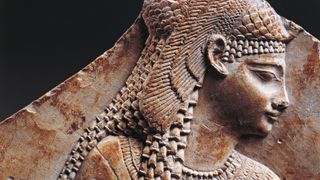
A bas relief fragment portraying Cleopatra (Image credit: Photo By DEA PICTURE LIBRARY/De Agostini via Getty Images)
Cleopatra VII may have been the most famous woman in the ancient world. She was the last of a dynasty that ruled ancient Egypt for around 300 years, from the death of Alexander the Great to the rise of the Roman Empire.
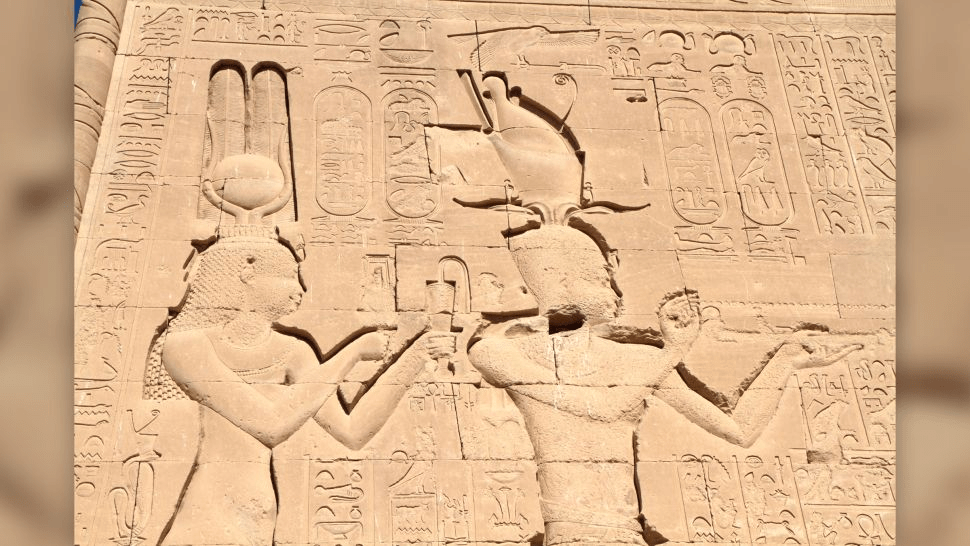
Her face has been immortalized on a handful of artifacts from the ancient world, including coins and a relief. Perhaps the best known depiction of her is a relief at Dendera temple in Egypt that shows her alongside her son Caesarion.
But despite these ancient depictions, we actually know very little about what the ancient world’s most powerful woman looked like. In recent years, that controversy has centered on a contentious topic:
What color was Cleopatra’s skin?
The archaeological record doesn’t leave us many clues, experts told Live Science. Her body has never been found, and depictions made at the time were likely not intended to be a true representation of her physical attributes.
“We simply do not have evidence from the ancient world that indicates Cleopatra’s skin tone,” Prudence Jones, a professor of classics and general humanities at Montclair State University, told Live Science in an email.
What’s more, our conception of skin color as “white” or “Black” would have been foreign to the ancient people living at the time.
Cleopatra VII reigned from roughly 51-30 B.C. and was the last ruler of the Ptolemaic dynasty, which ruled Egypt for nearly 300 years. When Julius Caesar came to Egypt she had a son with him called Caesarion. Later she had a romance with Mark Antony which resulted in the birth of three children. After the forces of Octavian conquered Egypt in 30 B.C. she committed suicide.
Profile of Cleopatra on the side of the Egyptian 50 fifty piaster (A.D. 2021).
What was Cleopatra’s skin color?
The artifacts we have today are not numerous. They include coins minted of her that have been found at the site of Taposiris Magna in Egypt. There are a number of statues that may depict Cleopatra VII which are now located in museums scattered around the world. However, the provenance of these statues is uncertain and whether they really depict Cleopatra VII is debated.
These artifacts, and the relief at Dendera, don’t tell us much about what she looked like.
Andrew Kenrick, a visiting research fellow at the University of East Anglia in the U.K., said that ancient writers usually did not discuss what ancient figures looked like. Kenrick also noted that ancient statues can be misleading. “Sculptures and statues were intended as projections of various facets of a figure, rather than intended as a true likeness,” Kenrick told Live Science in an email. For instance, a sculpture may depict a ruler as being more muscular than they actually were.
Additionally, we don’t know the identity of Cleopatra’s mother or paternal grandmother, Kenrick noted, which means it’s possible Cleopatra could have had some African descent.
Cleopatra’s statue with Asp snake seen on display during a press visit to “Pharaohs Superstars” in Gulbenkian Foundation on November 24, 2022, in Lisbon, Portugal. (Image credit: Photo by Horacio Villalobos/Corbis via Getty Images)
“What we do know is that Cleopatra’s father was Greek, and she would have considered herself to be Greek — although she did portray herself to be Egyptian, when it suited her politically,” Kenrick said. At times the Ptolemies married within their own family and Cleopatra VII was married to her brother Ptolemy XIV before he was killed in 44 B.C.
However, Zahi Hawass, the former Egyptian antiquities minister, believes her Greek parentage points clearly to one answer.
“Cleopatra was not Black,” Hawass said in response to Adele James, a biracial actress, being cast to play the queen in the Netflix show “Queen Cleopatra.”
“As well documented history attests, she was the descendant of a Macedonian Greek general who was a contemporary of Alexander the Great. Her first language was Greek and in contemporary busts and portraits she is depicted clearly as being white,” Hawass wrote in a column for Arab News at the time. Hawass did not return Live Science’s request for comment at the time of publication.
Can skeletal remains reveal what Cleopatra looked like?
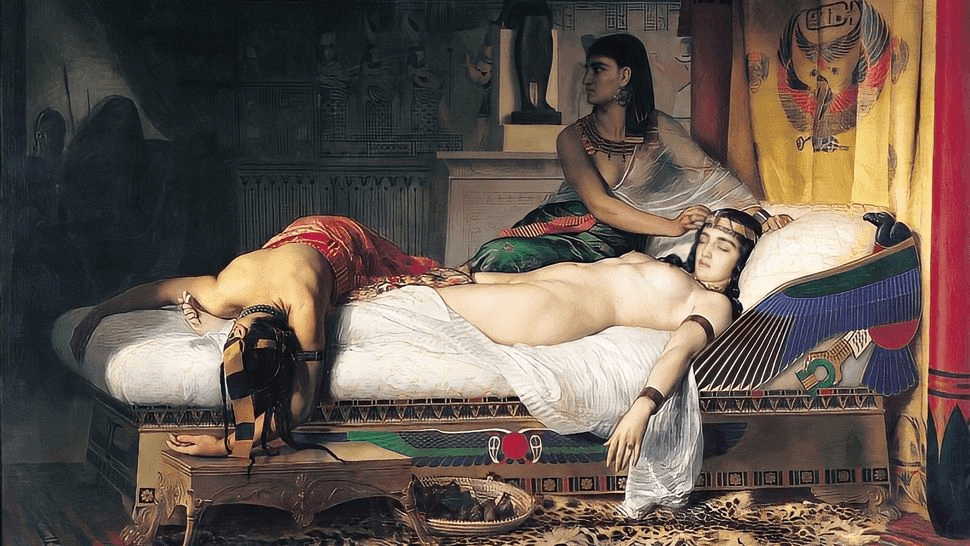
This is a painting called The Death of Cleopatra (1874) by Jean-André Rixens. (Image credit: Creator:Jean-André Rixens, Public domain, via Wikimedia Commons)
In 2009, the BBC aired a documentary called “Cleopatra: Portrait of a Killer” in which the documentary-makers talked to researchers examining skeletal remains found in 1926 in a tomb at Ephesus in modern-day Turkey. The researchers believed that the bones belong to Arsinoë IV, a sister of Cleopatra who was killed on the orders of Mark Antony in 41 B.C. Ancient records indicate that Cleopatra encouraged the killing, fearing that Arsinoë would try to take her throne.
Though the skull was lost during World War Two, the team reconstructed and analyzed the skull using old photographs and drawings and claimed they identified cranial features that suggest Arsinoë IV’s mother was of African descent.
“The distance from the forehead to the back of the skull is long in relation to the overall height of the cranium and that is something which you see quite frequently in certain populations, one of which is ancient Egyptians and another would be Black African groups,” which could suggest that Arsinoë IV had mixed ancestry, Caroline Wilkinson, an anthropology professor at the University of Liverpool, said in the documentary.
If one assumes that Arsinoë IV was Cleopatra’s full sister, this would suggest the queen may have been of partly African descent, the researchers noted. However, a literature search did not reveal any published research in a scientific journal detailing these reconstructions. The researchers who made the suggestions did not return requests for comment at time of publication. And a 2021 study in the Journal of Forensic Scientists found that when forensic anthropologists tried to estimate ancestry for 251 skulls from people in the U.S. of “mixed” ancestry, they were wrong 80% of the time.
The scholars that Live Science talked to were either unaware of the claims or cautious about these findings. Duane Roller, a professor emeritus of classics at Ohio State University, said that Cleopatra and Arsinoë may not have had the same mother. The ancient writer Strabo (63 B.C. to A.D. 24), who lived in Alexandria, wrote that Ptolemy XII, the father of Cleopatra, had children through multiple mothers.
As such “we have no idea who the mother of Cleopatra and Arsinoë was, or even if they were the same person,” Roller told Live Science in an email.
Skin color in the ancient world
Massive sunk relief of Cleopatra (Cleopatra VII) and her son Caesarean decorates the south wall of the Temple of Hathor, Dendera, Egypt. (Image credit: TerryJLawrence via Getty Images)
Whatever Cleopatra’s skin tone was, the notion of “whiteness” or “Blackness” as conceived today would have been alien to ancient people. “The ancients simply didn’t care about it the way that modern and contemporary people do. It wasn’t relevant to them and their worldview, it made no difference to their feelings about Cleopatra. They were more concerned about her being Egyptian, Macedonian, a woman etc.,” Jane Draycott, a classics lecturer at the University of Glasgow’s school of humanities, told Live Science in an email.
That doesn’t mean some ancient people didn’t notice differences across cultural groups, Draycott said.
“The Romans commented on the white blonde and red-haired peoples in Northern Europe and the dark-skinned, ‘woolly’ haired people from Africa, and saw both groups as being different from themselves,” Draycott said..
Romans would not have considered themselves to have white skin but rather brown or olive-toned skin, Draycott said. This can be inferred from the fact that the Romans didn’t describe themselves as white but rather described people from northern Europe this way, noted Draycott.
Kenrick said that the Greeks would also not have considered themselves to be white. “Greek should not be equated with white, as the Greeks and Romans certainly didn’t consider themselves to be white” Kenrick said in an email.
Ultimately, Cleopatra’s skin color isn’t particularly important, Roller said.
“Cleopatra’s skin color has nothing to do with her accomplishments, which are immense,” Roller said.
Pyramids are iconic symbols of the ancient pharaohs’ power and technological prowess that still dominate the Egyptian skyline. But when were pyramids first built? And why were they constructed in the first place?
The first pyramid in Egypt was built by the pharaoh Djoser, who reigned nearly 4,700 years ago. More than a millennium later, ancient Egypt’s last pyramid built for a pharaoh was constructed for Ahmose I around 3,500 years ago. After that, Egyptian rulers were buried in underground tombs in the Valley of the Kings.
Put another way, the ancient Egyptian pyramids were built between about roughly 2700 B.C. and 1500 B.C. This makes the earliest pyramids about the same age as Stonehenge, which was initially built between 4,000 to 5,000 years ago. But the pyramids are much older than other ancient structures, including the Parthenon (447 B.C.), the Great Wall of China (220 B.C.) and the Colosseum (A.D. 80). The Neolithic temple Gobekli Tepe in Turkey, however, is older from 11,000 to 12,000 years ago.
Egypt’s first pyramid
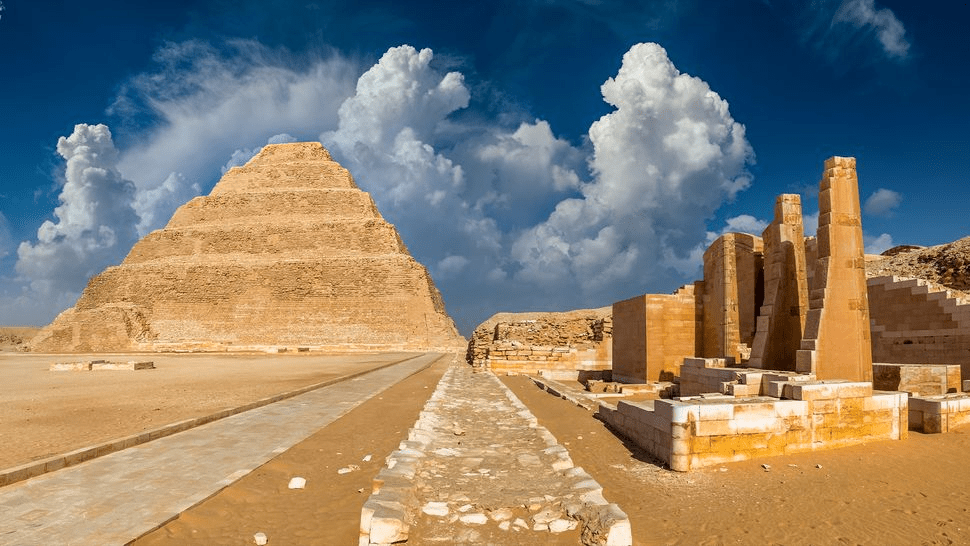
Djoser’s pyramid is made up of six layers and was originally built as a type of rectangular tomb known today as a mastaba (an Arabic word meaning “bench”) before being expanded into a step pyramid.
Ancient inscriptions indicate that a man named Imhotep directed the step pyramid’s construction. “Imhotep is usually regarded as the first architect in Egypt to build in stone and is credited with the building of Djoser’s step pyramid complex” Marc Van De Mieroop, a professor of history at Columbia University, told Live Science in an email. “There’s an inscription with his name combined with that of Djoser in which he is called chief of sculptors. In later ancient Egypt he was considered a sage,” Van De Mieroop added.
Why did The Egyptians build pyramids?
Researchers are still unsure exactly why pharaohs chose to use pyramids for their burials.
One reason may have been to provide added protection against tomb robbers. In earlier times robbers plundered pharaohs’ low-rising mastaba tombs by burrowing in from the top, Egyptologist Reg Clark wrote in his book “Securing Eternity: Ancient Egyptian Tomb Protection from Prehistory to the Pyramids” (American University in Cairo Press, 2019). The step pyramid, with its six layers on top of each other, would have offered protection from this method, Clark wrote. “Many Egyptologists have suggested that the step pyramid formed a kind of ‘stairway’ for the king to ascend to the sky, but I suggest that [it was built] because it is the most efficient and economical way to create a virtual ‘hemisphere’ of protection over the underlying substructure,” Clark told Live Science in an email.
Another important innovation was that stone was used to build the step pyramid, whereas the mastabas used by previous pharaoh were made of mudbrick; this was important as stone is harder to infiltrate, Clark noted.
Religious reasons may also have been an important factor. Miroslav Verner, a professor emeritus of Egyptology at Charles University in the Czech Republic, told Live Science in an email that “probably religious reasons were behind” the idea to build pyramids.
When Djoser came to power, the influence of the sun cult and the sun god Ra (also spelled Re) was increasing, Verner wrote in his book “The Pyramids: The Archaeology and History of Egypt’s Iconic Monuments” (American University in Cairo Press, 2021). The sun cult’s growing influence may have led to a desire to build structures that reached higher into the sky. Verner noted that a passage from a text dating back around 4,400 years said “may the sky make the sunlight strong for you, may you rise up to the sky as the Eye of Re” (translation by Raymond Faulkner).
One question is whether a growing interest in the sun cult brought about the construction of the step pyramid, or whether the construction of the step pyramid brought about an increasing interest in the sun cult. “What came first, the egg or the chicken?” Massimiliano Nuzzolo, a researcher at the Institute of Mediterranean and Oriental Cultures of the Polish Academy of Sciences in Warsaw, told Live Science in an email.
Nuzzolo thinks that interest in the solar cult grew after the construction of the step pyramid. “This incredible architectural enterprise may have also affected and somehow even pushed for a change in the religious ideology, eventually reflected on a major emphasis on the solar aspects of the kingship,” Nuzzolo said.
Built for a millennium
Whatever the reasons for building pyramids, Egyptian pharaohs constructed them for more than a millennium. The pharaoh Sneferu (reign circa 2575 to 2551 B.C.) built the first true pyramids (pyramids with flat sides) at Dahshur. These consisted of the Bent Pyramid (so named because of its unusual angle) and the Red Pyramid (named after its color). The Great Pyramid at Giza, the only one of the seven ancient wonders of the world that still stands, was built by Khufu (reign circa 2551 to 2528 B.C.) while Khafre (reign circa 2520 to 2494 B.C.) built another large pyramid, along with the Great Sphinx, at Giza.
The largest of the three main pyramids of Giza is Khufu’s Pyramid
It’s not clear why Egyptian pharaohs stopped building pyramids, but security concerns may have been part of it. Despite likely being harder to loot than mastabas, Egyptian pyramids were plundered in ancient times, and pharaohs may have hoped that building their tombs in the Valley of the Kings would make them harder to ransack. Additionally, the topography of the valley has a peak that today is called el-Qurn (sometimes spelled Gurn), which looks a bit like a natural pyramid.














 PLACES AND THINGS
.jpg)
You must be logged in to post a comment.